We have nothing but positive things to say about both Australia and New Zealand based on our recent experiences there. We hope that by sharing our experiences we've inspired you to also plan your own journey there. To help you get started, we are providing our itinerary and other tips and thoughts to make planning and preparing go a little smoother.
Showing posts with label Australia. Show all posts
Showing posts with label Australia. Show all posts
Monday, March 4, 2013

Saturday, January 5, 2013
Our Impressions of Australia
This is our summary of thoughts and impressions now that the Australian portion of our trip is complete.
Australians are friendly, proud of their country, and quite fond of the US. One quote we heard was that Australia was the 51st state. They dressed more similarly to the US than the UK, and had an obvious obsession with McDonalds.
Aussies love abbreviations, sometimes even abbreviating abbreviations. Examples include:
- sunnies (sunglasses)
- Maccas (McDonalds)
- mossies (mosquitos)
- brekkie (breakfast)
- cossies (swim costumes)
- footy (football)
- salties (saltwater crocs)
Pretty much anything that sounds "right" ending in -sie will be converted/abbreviated.
In addition to abbreviations, they also use different terminology:
- electrical storm (lightning)
- stingers (jellyfish)
- car park (parking lot - Ashley loves saying this now)
- caravan (RV/camper)
Australia is extremely expensive. Their dollar is slightly more than ours, but food and retail are all much costlier. Our favorite food deal sign in Sydney was "Deal of the day - Hamburger and glass of wine for $29 (AUD)." Fish and chips was frequently more than $20, and Maccers had a $2 menu rather than $1.
If willing to leave the cities you can actually spot the stereotypical Aussie wildlife. As mentioned in prior posts, we managed to spot koalas, emus, echidnas, penguins, Nemo, and allegedly a kangaroo all outside the confines of a zoo. We recommend asking locals about where to find specific animals. For example, we didn't see any mention of the St. Kilda penguins in our travel guide or in the blogs.
Overall, we had a great experience while in Australia. We'd like to revisit the same areas again, as well as see some other areas that were recommended to us by other travellers such as Kangaroo Island and Tasmania. Hopefully we'll be back. Until then, we'll just enjoy Bloomin Onions at Outback Steakhouse.
Australians are friendly, proud of their country, and quite fond of the US. One quote we heard was that Australia was the 51st state. They dressed more similarly to the US than the UK, and had an obvious obsession with McDonalds.
Aussies love abbreviations, sometimes even abbreviating abbreviations. Examples include:
- sunnies (sunglasses)
- Maccas (McDonalds)
- mossies (mosquitos)
- brekkie (breakfast)
- cossies (swim costumes)
- footy (football)
- salties (saltwater crocs)
Pretty much anything that sounds "right" ending in -sie will be converted/abbreviated.
In addition to abbreviations, they also use different terminology:
- electrical storm (lightning)
- stingers (jellyfish)
- car park (parking lot - Ashley loves saying this now)
- caravan (RV/camper)
Australia is extremely expensive. Their dollar is slightly more than ours, but food and retail are all much costlier. Our favorite food deal sign in Sydney was "Deal of the day - Hamburger and glass of wine for $29 (AUD)." Fish and chips was frequently more than $20, and Maccers had a $2 menu rather than $1.
If willing to leave the cities you can actually spot the stereotypical Aussie wildlife. As mentioned in prior posts, we managed to spot koalas, emus, echidnas, penguins, Nemo, and allegedly a kangaroo all outside the confines of a zoo. We recommend asking locals about where to find specific animals. For example, we didn't see any mention of the St. Kilda penguins in our travel guide or in the blogs.
Overall, we had a great experience while in Australia. We'd like to revisit the same areas again, as well as see some other areas that were recommended to us by other travellers such as Kangaroo Island and Tasmania. Hopefully we'll be back. Until then, we'll just enjoy Bloomin Onions at Outback Steakhouse.
New Zealand: On to Auckland
Its only a three hour flight to Auckland, but you lose two hours flying east. We landed around three pm, and in the international terminal were greeted by a large Maori carving and multiple "Welcome to Middle Earth" signs (which made Ashley laugh all through customs).
Auckland is a city of 1.2 million people, making up a quarter of New Zealand's total population. Their nickname is the City of Sails, with 170,000+ boats cruising around the many bays and coves.
We had heard about how friendly the Kiwis (New Zealanders) were, and we got a taste of it quickly. Due to construction in downtown, the airport express bus driver rerouted the bus and took us directly to our hotel. Keep in mind, this was a city bus from the airport, not a private shuttle.
Upon checking in, the front desk agent commented on how fortunate we were to have a breeze cool the city. Meanwhile, Ashley was putting on her jacket over a sweater.
Our main activity in Auckland was to be the Sky Tower (similar to Seattle or Toronto), the tallest building in the Southern Hemisphere. It provided 360 degree views of the city and was a favorite bungy jumping spot in the city. As we got closer to the Sky Tower, we saw a large gathering of people looking up and police blocking the road. Apparently, someone was outside on the Sky Walk hundreds of feet up and threatening to jump off. He had been out there for several hours, and there was no telling how long the Sky Tower would be closed. If you looked closely, you could see him walking around on the platform up high.

With no real back up plan, we had an early dinner at Elliott Stables. This was a unique food court with open seating in the middle and 10 or so small restaurants that used former horse stables as their kitchens. You picked a table (each had a number), and whichever restaurant or restaurants you ordered from would bring the food out to you.
After dinner, we went for a stroll down to the harbor along the north wharf and checked out the sailboats. There were several popular bars and eateries, and with no other plans we found ourselves relaxing with a few drinks as the sun set.

On the way back to the hotel we noticed that the Sky Tower was open (the jumper finally went back inside).

With an early morning the next day we decided to skip a night time trip up. In the morning we would need to catch an early bus back to the airport to get our rental car, and then head south to Waitomo Caves to see glowworms.
Auckland is a city of 1.2 million people, making up a quarter of New Zealand's total population. Their nickname is the City of Sails, with 170,000+ boats cruising around the many bays and coves.
We had heard about how friendly the Kiwis (New Zealanders) were, and we got a taste of it quickly. Due to construction in downtown, the airport express bus driver rerouted the bus and took us directly to our hotel. Keep in mind, this was a city bus from the airport, not a private shuttle.
Upon checking in, the front desk agent commented on how fortunate we were to have a breeze cool the city. Meanwhile, Ashley was putting on her jacket over a sweater.
Our main activity in Auckland was to be the Sky Tower (similar to Seattle or Toronto), the tallest building in the Southern Hemisphere. It provided 360 degree views of the city and was a favorite bungy jumping spot in the city. As we got closer to the Sky Tower, we saw a large gathering of people looking up and police blocking the road. Apparently, someone was outside on the Sky Walk hundreds of feet up and threatening to jump off. He had been out there for several hours, and there was no telling how long the Sky Tower would be closed. If you looked closely, you could see him walking around on the platform up high.

After dinner, we went for a stroll down to the harbor along the north wharf and checked out the sailboats. There were several popular bars and eateries, and with no other plans we found ourselves relaxing with a few drinks as the sun set.


Friday, January 4, 2013
Australia: A Hot Day in Melbourne
The talk of the day was how hot it would be - north of 36 celsius (97 fahrenheit). Our challenge with the heat was that we had planned to do a free walking tour (Peek Tours) that started at 10:30.
As we learned from our time in Sydney, there is a rivalry between Sydney and Melbourne. Sydney has a beautiful harbor and city, but Melbourne has culture. One of the tidbits we heard was that when Melbourne hosted the Olympics in the 50's, Sydney was so jealous that they commissioned the Opera House. However, the people we met in Melbourne seemed to talk less of how great their city was compared to those in Sydney.
We met up with the tour in Federation Square, which was just completed in the early 2000's. In planning out the city in the 1800's, land was divided and sold and then further subdivided. Because of the additional subdivision, Melbourne ended up with alleys between many sections. Today, these alleys have cafes, are often pedestrian friendly, and provide a European feel to the city.

The early city planners also never incorporated a city square, so now Melbourne finally had one with Federation Square. However, it was very modern (we liked it) against 100+ year old historic buildings, so there were varying opinions based on who you asked.

Our guide Ellen did a great job of keeping the group in the shade throughout the tour whether walking from one location to another or explaining the significance of a building or statue. She was passionate about her city, and took us through the block arcade, alleys with street art, Flinders Station, the CBD, and to the Royal Exhibition Hall.

One of the things Melbourne is known for is their trams. These are the primary mode of public transportation, and they even had a free tram that around the edges of downtown. Though they may look touristy, the trams are used heavily by locals and run throughout the city.

Another characteristic that Melbourne is known for is street art. We would typically categorize it just as grafiti, but they have a variety of types and styles.

It has been legalized within city limits in 11 specific sections (alleys), however, anyone caught with a can of spray paint (full or empty) is fined $550. Each alley/section has a curator, and you must get approval and an assigned "block" or area of wall before creating. Many political and social issues are expressed as street art in Melbourne.

At the end of the tour we walked through a park and stopped in front of a large white building that seemed to take up a whole city block. This was the Royal Exhibition Hall, site of the 1880 and 1888 World's Fair and also a world heritage site.

After the tour we had lunch at a US prohibition themed speak easy called Father's Office. Melbournians seem to like small (and themed) watering holes that only locals know about.
In the afternoon we did the old Gaol (jail - never did get why spelling was different). The gaol was established in the 1840's when Melbourne split from Sydney and could therefore no longer ship criminals to Sydney for trials or punishment.

The gaol has a good self guided tour of the history, experience of an inmate, and profiles on some inmates. The most infamous inmate was Ned Kelly, the Australian bushranger version of Robin Hood. There was even a reenactment of the Ned Kelly trial and a "locked up" experience at the decommissioned police station next door. During our lock up experience, the officer separated us by gender, had us stand single file with arms at our side, and locked us in holding cells.

We even took mugshots. You could spend hours here learning about old Melbourne, and it was a great way to spend time on a hot day.

After exploring the city, we took the tram to St. Kilda beach to celebrate our anniversary. We enjoyed dinner at Donovan's, which is a restored bathhouse located directly on the beach offering perfect views of the sunset. Earlier in the day, our tour guide tipped us off to a penguin viewing location at St. Kilda. So after dinner, we walked down the beach side promenade towards the pier.
The pier was sheltered by rocks on both sides, and tourists had already lined up on a small designated wooden platform to watch for penguins swimming up to the jetty. A member of the "penguin team" informed us that it was molting season and that fewer were coming back at night. Ashley and others scanned along the water's edge until someone pointed out a small dark shape. The little penguin swam near the rocks for about 10 minutes before deciding to climb onto a flat rock only 15 feet from us. Here, he groomed himself and put on a show for the next 30 minutes.

Gradually, more penguins came to the rocks, with each having its own personality. Ashley even found a good spot only 5 feet from one vocal penguin who continuously called out.

They eventually disappeared into their nooks and cubbies under the rocks. Ashley could not believe her luck in seeing penguins twice in the same week.
As we rode the tram back to our hotel, we both agreed that today had been a good way to end the Australian portion of our trip. Tomorrow, we'd be flying to Auckland for two Weeks in New Zealand.
As we learned from our time in Sydney, there is a rivalry between Sydney and Melbourne. Sydney has a beautiful harbor and city, but Melbourne has culture. One of the tidbits we heard was that when Melbourne hosted the Olympics in the 50's, Sydney was so jealous that they commissioned the Opera House. However, the people we met in Melbourne seemed to talk less of how great their city was compared to those in Sydney.
We met up with the tour in Federation Square, which was just completed in the early 2000's. In planning out the city in the 1800's, land was divided and sold and then further subdivided. Because of the additional subdivision, Melbourne ended up with alleys between many sections. Today, these alleys have cafes, are often pedestrian friendly, and provide a European feel to the city.


In the afternoon we did the old Gaol (jail - never did get why spelling was different). The gaol was established in the 1840's when Melbourne split from Sydney and could therefore no longer ship criminals to Sydney for trials or punishment.


The pier was sheltered by rocks on both sides, and tourists had already lined up on a small designated wooden platform to watch for penguins swimming up to the jetty. A member of the "penguin team" informed us that it was molting season and that fewer were coming back at night. Ashley and others scanned along the water's edge until someone pointed out a small dark shape. The little penguin swam near the rocks for about 10 minutes before deciding to climb onto a flat rock only 15 feet from us. Here, he groomed himself and put on a show for the next 30 minutes.


As we rode the tram back to our hotel, we both agreed that today had been a good way to end the Australian portion of our trip. Tomorrow, we'd be flying to Auckland for two Weeks in New Zealand.
Thursday, January 3, 2013
Australia: The Great Ocean Road
The next two days would primarily be spent driving and exploring the Great Ocean Road west of Melbourne. This stretch of road hugged the coastline and cliffs similar to highway 1 in California.
It was going to be Nate's first time driving on the opposite side of the road, so we timed our flight from Sydney to Melbourne so that we landed shortly after rush hour. We grabbed the car, a GPS, and hit the highway. Being on a large highway gave Nate some time to get comfortable and to stop using the windshield wipers (left of steering wheel) instead of the blinkers (right of steering wheel). Windshield wipers on a sunny day is the indication that a tourist wants over. It took about an hour to get to Geelong, and shortly after was the official start of the road.
Because it was a holiday week, it felt as if half of Melbourne was travelling on this 2 lane road (one lane each way). Each beach town had a central roundabout which usually caused a backup of 1-2 kilometers. Rumble strips were a frequent experience today because the car would drift left due to how close oncoming cars felt when driving from the right seat. The drive itself was pretty, with the coast hugging the road to our left.

We decided to stop in Lorne for lunch and had the first decent burger since home at Bottle of Milk. Lorne also had an information center that we visited to get some advice on lookouts and where to find koalas.
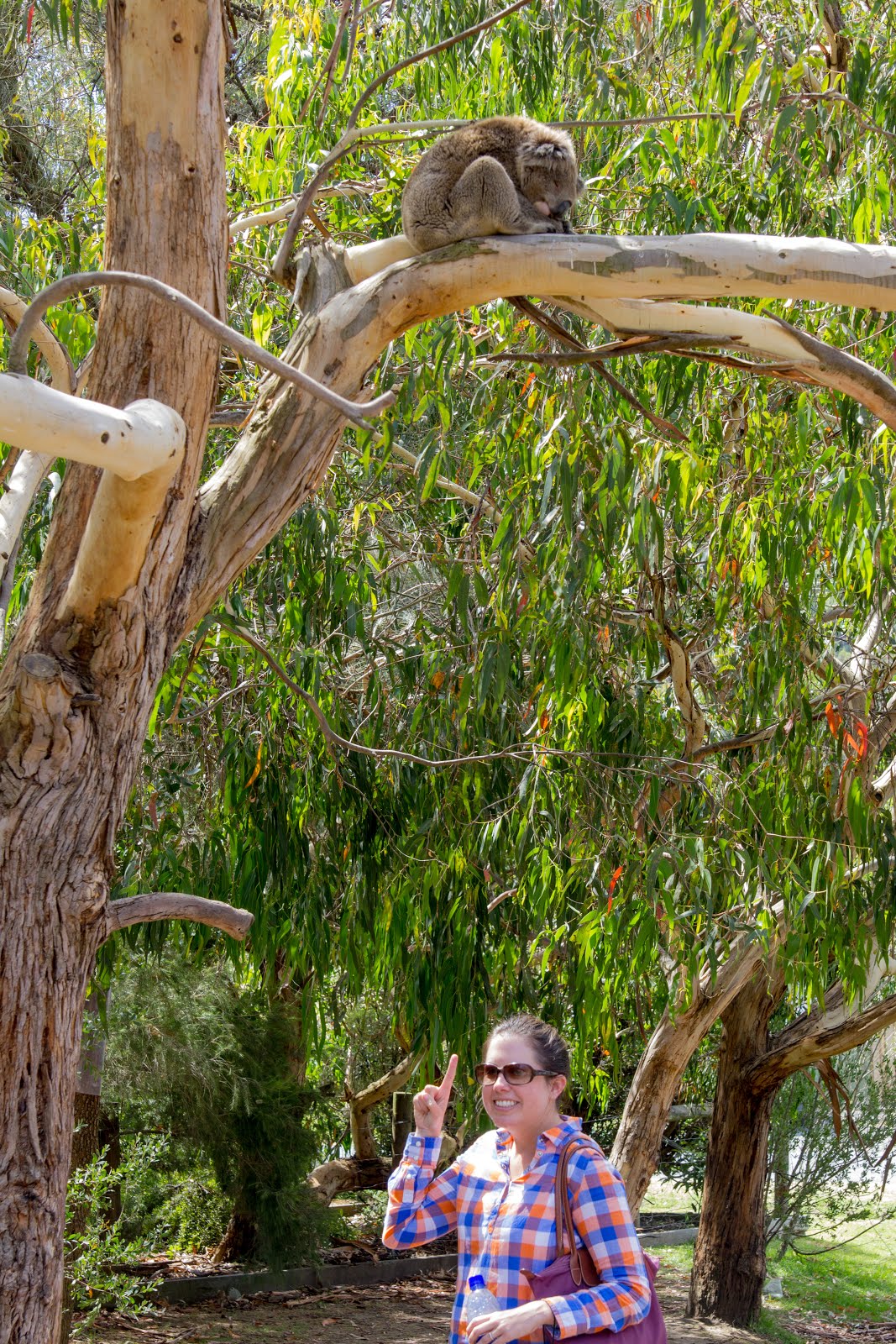
Based on our tip from Lorne, we stopped off at Kennett River before Apollo Bay. After parking near a cafe, we walked up the road and noticed a family looking up into a Eucalyptus tree. Sleeping on the lowest branch was a koala, only 10 feet above our head.

In a nearby tree was a second koala. We were encouraged to keep walking up the road, as the Great Otway national park was just ahead. A ten minute walk took us to where eucalyptus trees became denser, and with more trees came more koalas. For the most part, they were sleeping 50+ feet up, so it took us some time to figure out how to find them.

In our hour walking around Kennett River we found 13 koalas, with the first being the closest for pictures. We were excited to see so many in the wild, and we met some Aussies on this trip who hadn't seen any themselves.

We continued on past Apollo Bay, making several stops at the outlooks with views of the coast. After Apollo Bay, the road swings inland into Great Otway NP and turns into a windy, mountainous type road with tight turns. It was through here that Ashley swears she saw a kangaroo munching on leaves (no photo evidence can be provided). Nate, being the responsible driver, missed it due to a tight turn and the angle of the sun. It would be the only wild kangaroo spotted on our trip.

Our B&B was located beyond Great Otway but before Port Campbell national park, approximately 10 km inland amongst rolling hills and pastureland. It looked nothing like any images of Australia we had seen. And it had a name that fit it perfectly, 12 Apostles Secret Spot. Robin, the owner, greeted us and took us to our room. After dining recommendations she encouraged us to visit the 12 Apostles at sunset and stay until dusk in order to see the local little penguins. Ashley was excited to learn that she would see penguins with some patience and a sharp eye.
The 12 Apostles are the highlight of the Port Campbell national park and are said to be the 2nd most photographed natural object in Australia behind Uluru (Ayers Rock). They are huge pillars of stone that are left standing from the erosion of the cliffs. Today, only 8 are still standing as the waves continue their daily assault.
We arrived at 12 Apostles shortly before sunset, and tripods lined the wooden platform overlooking the pillars below. We found some space with a view and enjoyed the changing light over the rocks for the next 30 minutes.

Most visitors began leaving after the sun disappeared, and after some checking we decided on a spot where the penguins were supposed to wash ashore down below (~100 feet below). Ashley and others were peering intently at the water line along the beach, but it wasn't until 30 or so minutes after sunset that the first penguin was spotted. Because of the distance and the darkness, it was a small black blob near the top of the water line. The black clump slowly grew in size until enough penguins (~10) were together to safely march up the beach to their nighttime home in the bushes and rocks up against the cliff base.

Once they reached the first few plants, it became a free-for-all dash for safety. Behind them was a clear line in the sand where they had marched from the ocean. As one group marched up, the next group of penguins began clumping along the water's edge. We stayed for 4 separate groups of penguins and their parade up the beach before Ashley agreed to call it a night. It had been a good day for spotting animals.
The next morning we were up before first light in order to see the sunrise at the 12 Apostles. The sunrise would be coming from the east, meaning we had a different view than the night before. There were already several others who beat us to the best spot, but Nate found some room to set up. The sunrise was beautiful, with an orange pink coloring across the clouds for nearly 30 minutes.

After getting back to our B&B, we had some time to take a few pictures of the view and clean up before breakfast.

Breakfast was served at 8, cooked to order by Robin with fresh eggs from her chickens. She sat with us and another couple as we ate, sharing stories about her and the area. It felt as if we were a part of her family. Her dog Lamb was a curly coated lab (think black fur like a poodle except around the head) and was super friendly and sweet. He was always running about the garden and picking up leaves and other items in his fur. Before we knew it, almost two hours had passed since the start of breakfast. Having to leave, Robin gave us hugs and wished us well on the remainder of our trip. It was such a nice experience, and we would highly recommend anyone coming out this way to stay here.
Nate had to make one more stop at 12 Apostles because we hadn't seen them in full daylight.

We continued westward along the Great Ocean road towards Warnambool. Stops along the way included formations named London Bridge, Loch Arch, and Bay of Martyrs. Eventually the road turned inland and we left the coast behind.

Near Warnambool was Tower Hill State Reserve, a protected state park where many of the iconic Australian animals could be seen in their natural environment. The park was located on an island within a crater and had several short hikes that provided a good chance at seeing wildlife.

After talking with one of the guides, we decided on Watson's Bay. On the hike and surrounding area we saw 2 more koalas, 6 emus, 2 echidnas (a small porcupine), and a mystery dark snake that may or may not have been deadly. Unfortunately, it was a very hot day, so no kangaroos or wallabies were spotted.

To get back to Melbourne we took the inland route via Princes Highway. We dropped the car at the airport in order to avoid the dreaded hook turn (look this up on YouTube) in downtown Melbourne.
Melbourne has a well established China Town, similar but smaller than San Francisco's. The concierge recommended Sichuan House (the suburban location was on Bourdain's show). For those that didn't know, authentic Sichuan food is very spicy, with Kung Pao a well known dish (though softened to American tasyes). We decided on staying at moderate spiciness, or 2 out of 3 chilis. Nate had the chicken wok and Ashley went with the Kung Pao chicken. Nate scarfed down his dish, but Ashley ended up with a runny nose due to how spicy it was. We had ordered soya milk to help combat the heat, and Ashley finished hers nearly immediately and also drank half of Nate's. It was a great place to eat and we both enjoyed trying something new.
Tomorrow we would brave the heat and explore Melbourne.
It was going to be Nate's first time driving on the opposite side of the road, so we timed our flight from Sydney to Melbourne so that we landed shortly after rush hour. We grabbed the car, a GPS, and hit the highway. Being on a large highway gave Nate some time to get comfortable and to stop using the windshield wipers (left of steering wheel) instead of the blinkers (right of steering wheel). Windshield wipers on a sunny day is the indication that a tourist wants over. It took about an hour to get to Geelong, and shortly after was the official start of the road.
Because it was a holiday week, it felt as if half of Melbourne was travelling on this 2 lane road (one lane each way). Each beach town had a central roundabout which usually caused a backup of 1-2 kilometers. Rumble strips were a frequent experience today because the car would drift left due to how close oncoming cars felt when driving from the right seat. The drive itself was pretty, with the coast hugging the road to our left.

Based on our tip from Lorne, we stopped off at Kennett River before Apollo Bay. After parking near a cafe, we walked up the road and noticed a family looking up into a Eucalyptus tree. Sleeping on the lowest branch was a koala, only 10 feet above our head.


The 12 Apostles are the highlight of the Port Campbell national park and are said to be the 2nd most photographed natural object in Australia behind Uluru (Ayers Rock). They are huge pillars of stone that are left standing from the erosion of the cliffs. Today, only 8 are still standing as the waves continue their daily assault.
We arrived at 12 Apostles shortly before sunset, and tripods lined the wooden platform overlooking the pillars below. We found some space with a view and enjoyed the changing light over the rocks for the next 30 minutes.
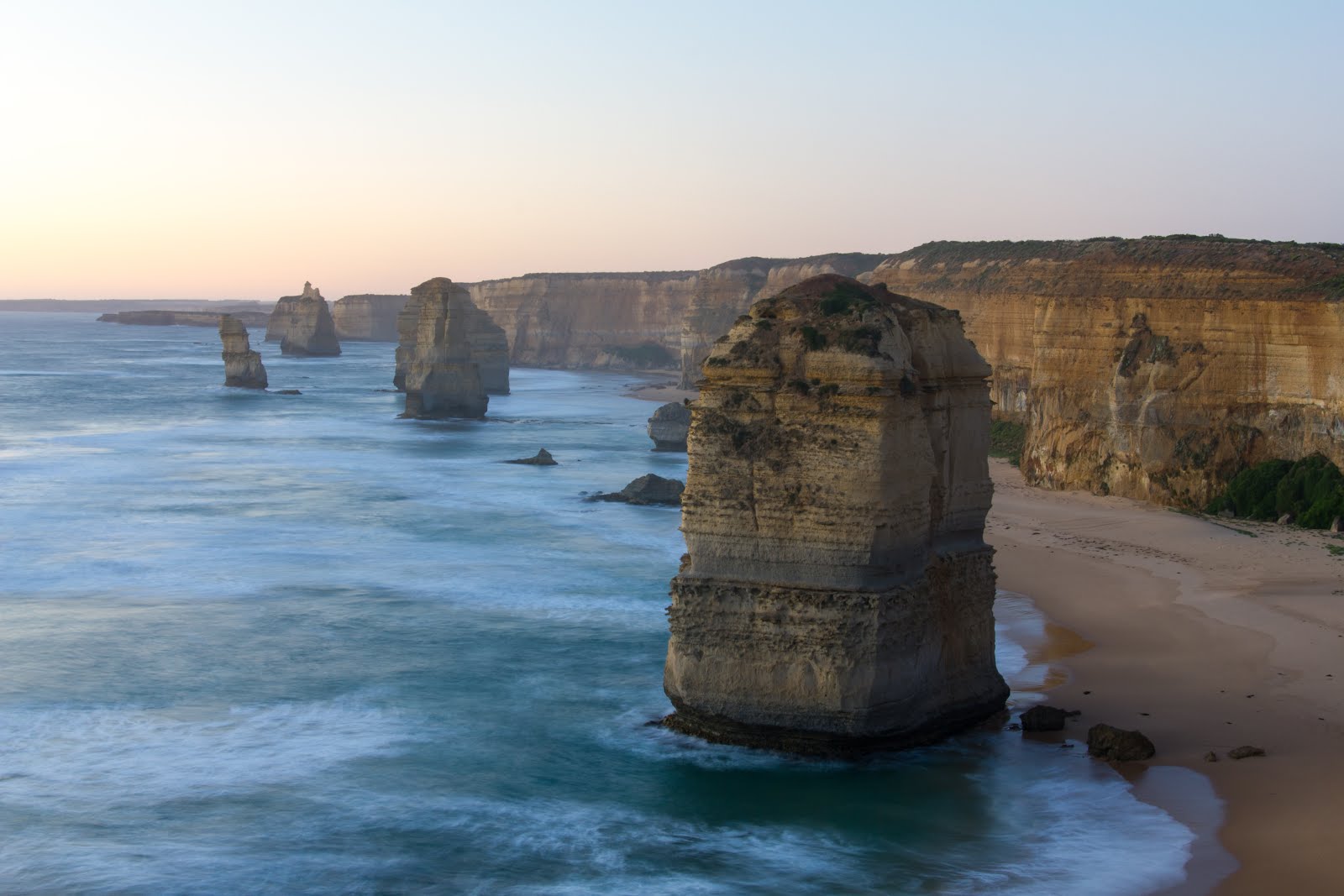

The next morning we were up before first light in order to see the sunrise at the 12 Apostles. The sunrise would be coming from the east, meaning we had a different view than the night before. There were already several others who beat us to the best spot, but Nate found some room to set up. The sunrise was beautiful, with an orange pink coloring across the clouds for nearly 30 minutes.


Nate had to make one more stop at 12 Apostles because we hadn't seen them in full daylight.


Melbourne has a well established China Town, similar but smaller than San Francisco's. The concierge recommended Sichuan House (the suburban location was on Bourdain's show). For those that didn't know, authentic Sichuan food is very spicy, with Kung Pao a well known dish (though softened to American tasyes). We decided on staying at moderate spiciness, or 2 out of 3 chilis. Nate had the chicken wok and Ashley went with the Kung Pao chicken. Nate scarfed down his dish, but Ashley ended up with a runny nose due to how spicy it was. We had ordered soya milk to help combat the heat, and Ashley finished hers nearly immediately and also drank half of Nate's. It was a great place to eat and we both enjoyed trying something new.
Tomorrow we would brave the heat and explore Melbourne.
Tuesday, January 1, 2013
Australia: Tour of the Blue Mountains
Despite knowing that we'd be ringing in the New Year the night before, we booked a tour of the Blue Mountains that started at 7:30 New Years morning. We decided we could sleep in at home and didn't want to waste our last day in Sydney. Others must have shared our sentiments because there were quite a few people at the hotel breakfast.
As you may know, Ashley isn't exactly the easiest person to wake up. However, she hopped right out of bed when Nate reminded her that she would get to pet a koala today.
Rob, our tour guide from Sydney Great Escapes, picked us up at our hotel. The company specializes in smaller sized group tours and our tour only had two other people on it. The Blue Mountains are a mountain range located about 1.5 hours west of Sydney and derive their name from the blueish haze produced from the oil emitted from the forest of eucalyptus trees. Our day started at Featherdale Wildlife Park, which is on the way to the mountains. As promised, we were the first to arrive at the wildlife park so we had the animals to ourselves for awhile.
The front area of the park is like an Australian petting zoo. As soon as we stepped through the gates, we were greeted by wallabies on the pathway. Rob picked some leaves for us to feed to the wallabies and encouraged us to pet them. From this point forward, Ashley had a giddy grin plastered across her face.

After the wallabies, we entered the, koala section of the park. They had some koalas in eucalyptus displays, but more importantly they had one available to pet and take pictures with. The koala happily snacked on her leaves while we took turns taking pictures of us petting her.

After the koalas, we were handed orange ice cream cones filled with greenery and pellets for the kangaroos. The kangaroos were initially slow and hesitant, but soon approached us after we entered their area.

They were much smaller than we were expecting, but Ashley's first cone was still pulled out of her hands as we realized that they used their upper limbs to grasp.

With a mutual level of comfort, we spread out and fed the kangaroos for a while. It was difficult to isolate a kangaroo from the emus also in the feeding area, but we finally tempted a few away from the main group.

The rest of the wildlife park was more of what you would expect of a zoo but focused only on Australian land animals. Some of our favorites were a very large saltwater croc, wombats, and blue penguins (also known as little penguins). We actually had a chance to see blue penguins in the wild later in the trip, so Ashley read every sign she could to learn more about them.

Unfortunately, the Tasmanian devils were hiding while we were there. However, we did learn that Lily, our puggle at home, was going to one day grow up to be an Echidna.

After 90 minutes at Featherdale we were again on our way towards the blue mountains. Rob took us via a route that is not heavily frequented by tour buses as he provided more information on the area. Rob had grown up in the area and had been a volunteer fire fighter for 30 years, so he was very knowledgeable and knew of lookouts that most would miss.
The blue mountains were a plateau carved out by wind and rain and not a result of an upward thrust due to tectonic shifts. There are sheer cliffs over 1000 feet high, with eucalyptus trees on top and a temperate forest down low. No river runs through it, and the topography and harshness of the environment prevented westward expansion of the Sydney colony for almost 50 years.

We did two hikes along narrow, unmarked "trails" to viewpoints overlooking valleys and cliffs. At the first stop, Rob began lobbing stones down the path in front of us in order to scare snakes from the path. The brown snake, red bellied black snake, and tiger snake all lived in this environment and were on the world's most venomous list. We mostly stared at the ground and walked very slowly after he told us of the locals.

It was also much drier than we had expected, and Rob informed us that they were beginning bush fire "season." Before the trip, we were both expecting this to be Australia's Smoky Mountains, but very little water was present. Unlike National Parks in the US, few formal hiking paths or facilities were available, limiting time in the bush (and encounters with deadly snakes). The park service believes that building and maintaining trails and facilities is detrimental to the environment, so a minimalistic approach is taken. Rob even mentioned that a good number of hikers get lost on the trails each year because they mistake a wombat path as an unmaintained trail.
After lunch we visited Scenic World near Katoomba. This is the place just about every tourist to the Blue Mountains will see and experience (and pay $25 a person). There are two cable cars, one crossing a canyon with expansive views of the Blue Mountains. The second is more of large gondola that takes you down into the temperate forest in the valley.

Once on the valley floor, there are boardwalks leading through tree ferns and the forest. Depending on the path you take, you could walk for 10 minutes or an hour. The valley floor was more what we were expecting from the Blue Mountains, with a greater variety of plants and animals, similar to a temperate rainforest.

The world's steepest railway at 52 degrees can take you back up to the top (or down). We got convinced to take a picture at the demo train, which was built to scale and steepness.

Rob had told us to ride this up, but the seats only face downward. There are no seat belts, so you literally have to brace yourself with your feet and grip the "cage" above your head or risk sliding out of your seat. The ride was less than two minutes, and the famous rock formation called Three Sisters greeted us at the top of the railway where we finished.

It had been a long day, so we stopped for coffee on the way back. While ordering, Nate was complimented on how beautiful his accent was. Silly Aussies. The trip back was along the main highway, and Rob shared stories and answered questions to help pass the time.
Overall, the tour itself was good. However, we were underwhelmed with the Blue Mountains. Part of this was likely due to our misconceptions of the place and also the lack of available hiking options and facilities. It meant more time in a van and less outside.
When we got back to Sydney we decided to walk across the Harbor Bridge to get a nice, high view of the city and the Opera House. This wasn't the bridge climb, which we felt was too expensive and you couldn't bring your own camera. The sun was setting and the lighting was good for photography.

Nate even managed to find a spot for nighttime shots of the Opera House (next to a giant yacht).

We enjoyed dinner at a place called the Glenmore, which had a rooftop bar and deck with a view of the Opera House. Surprisingly, it seemed to be mostly locals. Tourists could be identified because they were looking to the sky and pointing at fruit bats flying over the city.
With a very long day over, we said goodbye to Sydney. Next stop, Melbourne and the Great Ocean Road.
As you may know, Ashley isn't exactly the easiest person to wake up. However, she hopped right out of bed when Nate reminded her that she would get to pet a koala today.
Rob, our tour guide from Sydney Great Escapes, picked us up at our hotel. The company specializes in smaller sized group tours and our tour only had two other people on it. The Blue Mountains are a mountain range located about 1.5 hours west of Sydney and derive their name from the blueish haze produced from the oil emitted from the forest of eucalyptus trees. Our day started at Featherdale Wildlife Park, which is on the way to the mountains. As promised, we were the first to arrive at the wildlife park so we had the animals to ourselves for awhile.
The front area of the park is like an Australian petting zoo. As soon as we stepped through the gates, we were greeted by wallabies on the pathway. Rob picked some leaves for us to feed to the wallabies and encouraged us to pet them. From this point forward, Ashley had a giddy grin plastered across her face.


The blue mountains were a plateau carved out by wind and rain and not a result of an upward thrust due to tectonic shifts. There are sheer cliffs over 1000 feet high, with eucalyptus trees on top and a temperate forest down low. No river runs through it, and the topography and harshness of the environment prevented westward expansion of the Sydney colony for almost 50 years.


After lunch we visited Scenic World near Katoomba. This is the place just about every tourist to the Blue Mountains will see and experience (and pay $25 a person). There are two cable cars, one crossing a canyon with expansive views of the Blue Mountains. The second is more of large gondola that takes you down into the temperate forest in the valley.


Overall, the tour itself was good. However, we were underwhelmed with the Blue Mountains. Part of this was likely due to our misconceptions of the place and also the lack of available hiking options and facilities. It meant more time in a van and less outside.
When we got back to Sydney we decided to walk across the Harbor Bridge to get a nice, high view of the city and the Opera House. This wasn't the bridge climb, which we felt was too expensive and you couldn't bring your own camera. The sun was setting and the lighting was good for photography.


With a very long day over, we said goodbye to Sydney. Next stop, Melbourne and the Great Ocean Road.
Australia: New Years Eve in Sydney
Sydney is one of the first major cities in the world to ring in the new year and the fireworks and celebration are broadcast around the world. When we first decided on Australia and New Zealand for our trip, this was a must-do, once in a lifetime experience. New Year's Eve in Sydney wasn't really the driving reason for this trip, but we did plan everything else around it. We were not disappointed.
As mentioned in a prior post, nearly one million people come to Sydney to watch the fireworks. Many locations around the city are free and open to the public, but you have to line up early in the morning and sit or stand in "your" place all day to keep your spot. Rather than spend a full day with a million of our closest friends, we instead chose to buy tickets in the botanical garden months prior to ensure a good view and to see more of the city midday.
With our extra time we traveled out to Bondi beach in the morning to hike the Bondi to Coogee track. Bondi and Manly (day before) are the two iconic beaches of Sydney with lifeguards, surfers, and tanned bodies. Bondi was a wide and fairly long beach, and it was packed!

Tourists, including us, were watching and photographing the surfers clustered in the areas where the waves broke right.

The water was cold to us, but heaps (Aussie for lots) of people were swimming and playing in it.

The Bondi to Coogee track proved to be a very popular hike. It's a paved trail of 6 kilometers that takes you along cliffs and past small beaches and coves. Along the way, multiple dramatic lookouts provided great views of Bondi and the coast.

Every half kilometer the view changed to a new series of cliffs either ahead of us or behind. It also seemed as if a new, small beach was around every corner that only the locals knew about. There was even a workout circuit along the path and a good number of joggers. In total, the hike took about two hours to get to Coogee. Fortunately, there are restaurants or barbies (grills) if you brought your own food.

We had to get back into Sydney by 3 pm to avoid road closures, so we didn't get to spend much time in Coogee. Sydney was buzzing when we were dropped off near our hotel, and they had already closed off most of the public viewing areas because max capacity had been reached. Our designated area would not let anyone in until 6:30, so we had time to relax and clean up.
For crowd control reasons the botanical gardens had been fenced off with only one entrance. We wound our way around until we found the sign for our event, called Midnight at the Oasis. Included was a designated table, food (appetizer, dinner, dessert), and open bar. Once past bag check and a short walk, each guest was handed a sparkling wine and the fun began. Just beyond, the sound of a few hundred revelers grew louder. Most found their tables and then quickly found their way to the railing to get their pictures with the Opera House and bridge behind them.

The view we had from our table would be perfect for the fireworks.

Straight ahead was the Opera House and bridge, downtown was to our left, and the harbor and larger boats were to our right.

Midnight at the Oasis had good spacing between the food and fireworks. We were provided a snack box when we entered (with our sparkling wine) around 7, and then dinner was available starting at 7:30. There were two open bars serving local beers, wine, and sparkling wine. The children's fireworks were at 9, so Nate found a spot along the railing to get some photos. A good number of attendees had brought tripods for this, but Nate had left his in the room because we didn't know if they would be allowed in.

They lasted about 10 minutes and were mostly coming from near the bridge, with periodic bursts from downtown and a barge in the harbor.

If these were the small fireworks, then we had a lot to look forward to at midnight.

Shortly after the family fireworks had ended the dance floor opened up. This would provide entertainment for the dancers and the public who sat above on a hill and watched. For those not interested in dancing (or watching), a boat parade occurred in the harbor for the next hour. Many of the dinner cruise boats had New Years Eve parties tonight, and a selection of these were lit up in reds or yellows while they participated in the parade.

There were two types of tables at our event: long ones that sat 10 and small circular ones that sat 4. We had our own circular table until about 11:30, when an older couple showed up. They were already well into celebrating, and apparently had been visiting a friend who lived in the apartment next to the Opera House and almost didn't make it. They were a fun couple to talk with for the next 30 minutes.
At 3 minutes till midnight, the countdown began on the bridge pylons. The last 10 seconds were loud, as everyone counted to 1. On cue, the fireworks erupted across the sky from the skyscrapers to our left, the bridge in the center, and from a barge to our right in the water. It was hard to stay focused on more than one or two spots.

The highlight, besides the grand finale, was the "waterfall" effect of fireworks cascading under the bridge.

After the finale, a loud cheer and clapping was heard. All total, Sydney spent $6.6 million on fireworks, and it was a great display.
We only lasted another 30 minutes, because we had planned an early morning trip to the blue mountains tomorrow.
As mentioned in a prior post, nearly one million people come to Sydney to watch the fireworks. Many locations around the city are free and open to the public, but you have to line up early in the morning and sit or stand in "your" place all day to keep your spot. Rather than spend a full day with a million of our closest friends, we instead chose to buy tickets in the botanical garden months prior to ensure a good view and to see more of the city midday.
With our extra time we traveled out to Bondi beach in the morning to hike the Bondi to Coogee track. Bondi and Manly (day before) are the two iconic beaches of Sydney with lifeguards, surfers, and tanned bodies. Bondi was a wide and fairly long beach, and it was packed!


For crowd control reasons the botanical gardens had been fenced off with only one entrance. We wound our way around until we found the sign for our event, called Midnight at the Oasis. Included was a designated table, food (appetizer, dinner, dessert), and open bar. Once past bag check and a short walk, each guest was handed a sparkling wine and the fun began. Just beyond, the sound of a few hundred revelers grew louder. Most found their tables and then quickly found their way to the railing to get their pictures with the Opera House and bridge behind them.


At 3 minutes till midnight, the countdown began on the bridge pylons. The last 10 seconds were loud, as everyone counted to 1. On cue, the fireworks erupted across the sky from the skyscrapers to our left, the bridge in the center, and from a barge to our right in the water. It was hard to stay focused on more than one or two spots.


We only lasted another 30 minutes, because we had planned an early morning trip to the blue mountains tomorrow.
Subscribe to:
Posts (Atom)